GLOW vs KLOW: The Difference at a Glance
GLOW combines GHK-Cu, BPC-157 and TB-500. KLOW adds KPV. In the 70 mg GLOW and 80 mg KLOW formulations compared here, the quantities of the three shared ingredients stay the same; the extra 10 mg is KPV.[2, 3]
GLOW
Two featured vial formulations:
50 mg and 70 mg.
KLOW
Compared here using the supplier's
80 mg specification.
That makes GLOW 70 the clearest starting point for this comparison. GLOW 50 uses a different ingredient split, so moving from that vial to KLOW changes more than the presence of KPV.
The useful question is not simply which blend has more milligrams. It is whether the formulation includes the components required for the research, at the specified amounts, with documentation that identifies the material.
GLOW 50, GLOW 70 and KLOW 80: Exact Ingredient Amounts
The two GLOW columns below come from the supplied batch certificates. The KLOW column uses PrymaLab's published 80 mg product specification. These are the specific formulations being compared, rather than a universal recipe for every product using either name.[1, 2, 3]
| Declared contents | GLOW 50 mg | GLOW 70 mg | KLOW 80 mg |
|---|---|---|---|
| GHK-Cu | 35 mg | 50 mg | 50 mg |
| BPC-157 | 5 mg | 10 mg | 10 mg |
| TB-500 | 10 mg | 10 mg | 10 mg |
| KPV | Not an ingredient | Not an ingredient | 10 mg |
| Total labeled blend | 50 mg | 70 mg | 80 mg |
GLOW 70 vs KLOW 80
For this pair, the formulation change is easy to isolate: KPV is added without increasing GHK-Cu, BPC-157 or TB-500. The 80 mg total is approximately 14.3% higher than 70 mg, but that arithmetic does not establish 14.3% greater potency or effectiveness.
GLOW 50 vs GLOW 70
The 70 mg vial is not simply the 50 mg formula multiplied by the same factor. GHK-Cu increases from 35 to 50 mg, BPC-157 increases from 5 to 10 mg, and TB-500 remains at 10 mg. The ingredient proportions change.[1, 2]
The GLOW certificates identify TB-500 as 43-residue thymosin beta-4. That specific identity should be matched to the research being discussed, rather than treating every TB-500 label as interchangeable.[1, 2] See the GLOW formulation overview.
What Does KPV Add to KLOW?
KPV is the tripeptide lysine-proline-valine. Its addition introduces another research target, particularly around inflammatory signaling and intestinal biology.[4]
Three amino acids. A distinct research question added to the blend.
In a study published in Gastroenterology, researchers examined KPV in human intestinal epithelial and immune cell lines, and in two mouse models of colitis. They reported reduced activation of NF-kappaB and MAP kinase signaling pathways, lower pro-inflammatory cytokine secretion, and reduced inflammation in the mouse experiments.[4]
The study links these findings to uptake through the peptide transporter PepT1. It investigated KPV, not the complete KLOW mixture, and it was not a treatment trial in people.[4]
To test an added effect, a comparison would need to keep the shared ingredients and other conditions consistent while assessing the contribution of KPV. Simply comparing two testimonials cannot isolate what the fourth ingredient did.
GLOW vs KLOW Benefits: Skin, Recovery and Inflammation
The three shared ingredients explain much of the overlap in discussions about these blends. The most useful comparison separates research on those ingredients from research specific to KPV.
| Research question | Shared by both | What KPV changes |
|---|---|---|
| Collagen biology | GHK-Cu is present in both formulations. | Its addition does not establish a larger collagen effect. |
| Tissue repair | BPC-157 and thymosin beta-4 are common components. | A fourth component, not a demonstrated recovery advantage. |
| Inflammatory signaling | Interpret findings for each exact substance and study model. | KPV contributes its own cell and animal research. |
Skin and collagen
A primary GHK-Cu study reported increased collagen synthesis in cultured fibroblasts. This supports a laboratory research theme shared by GLOW and KLOW. It does not show that either finished blend reduces wrinkles, nor that adding KPV improves the cosmetic outcome.[5]
Tissue repair and recovery
BPC-157 has been studied in tendon explants and cultured tendon cells. Researchers observed changes in outgrowth, survival under stress and migration. Those experiments help explain interest in repair-related biology, but did not compare GLOW with KLOW or establish a recovery schedule in people.[6]
Full-length thymosin beta-4 has also been studied as a topical preparation in a randomized Phase II venous-ulcer trial with 73 participants. That is a different formulation, route and clinical setting from either blend. It cannot establish that a vial or pen provides the same result.[7]
Inflammation and gut-related claims
KPV's cell and mouse findings explain the additional inflammation-focused research interest. They are not evidence that injecting KLOW treats inflammatory bowel disease, provides better recovery, or makes the other ingredients safer.[4]
The evidence reviewed here does not establish a clinical winner between the finished blends. Their component lists can be compared directly; their effectiveness cannot be ranked from those lists alone. Explore the GLOW benefits and research page for the broader ingredient evidence, or the before-and-after guide for evaluating result claims.
Which Blend Fits the Research Question?
A formulation decision starts with the components the work requires. GLOW is the three-component option; KLOW is the four-component option that includes KPV. That is a material-selection distinction, not an individualized treatment recommendation.[1, 2, 3]
Three specified components
A relevant starting point when the work concerns GHK-Cu, BPC-157 and thymosin beta-4 without introducing KPV.
KPV included
A comparison material when KPV is part of the question and the protocol is designed to evaluate a four-component mixture.
If the question is specifically whether KPV changes an outcome, GLOW 70 and the stated KLOW 80 formula make a clearer compositional pair than GLOW 50 and KLOW 80: their shared labeled amounts match. Actual experiments still require matched component exposure and appropriate controls; equal total blend mass is not automatically an equivalent comparison.
Is KLOW stronger than GLOW?
It contains an additional ingredient, but "stronger" needs a defined outcome and evidence. Total blend mass, ingredient count and concentration describe a product; none is a general score for biological effectiveness.
Likewise, the simpler formula is not automatically proven safer. Selecting fewer ingredients can make a research question easier to define, but safety needs its own evidence.
For a purchase decision, prioritize the actual specification, batch documentation and suitability for the planned laboratory work. Do not pay for an extra component solely because a product is described as an upgrade.
Compare GLOW Vials and the 3 mL Autoinjector
The GLOW range featured here includes two freeze-dried vial formulations and a preloaded solution format. The choice changes the amounts and presentation, not the ingredient count.[1, 2, 8]
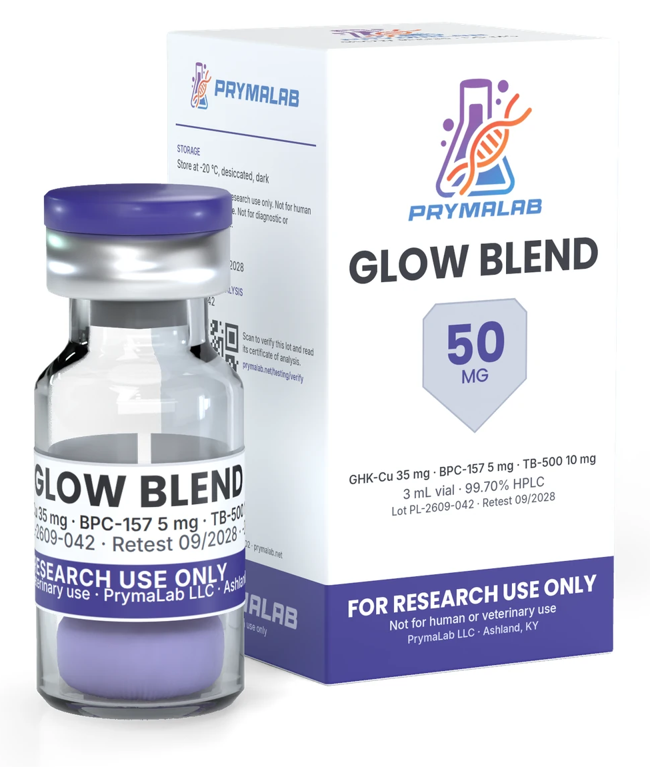
GLOW Blend 50 mg
LYOPHILIZED / 3 mL VIALThe 35 / 5 / 10 mg formula.
- GHK-Cu
- 35 mg
- BPC-157
- 5 mg
- TB-500
- 10 mg
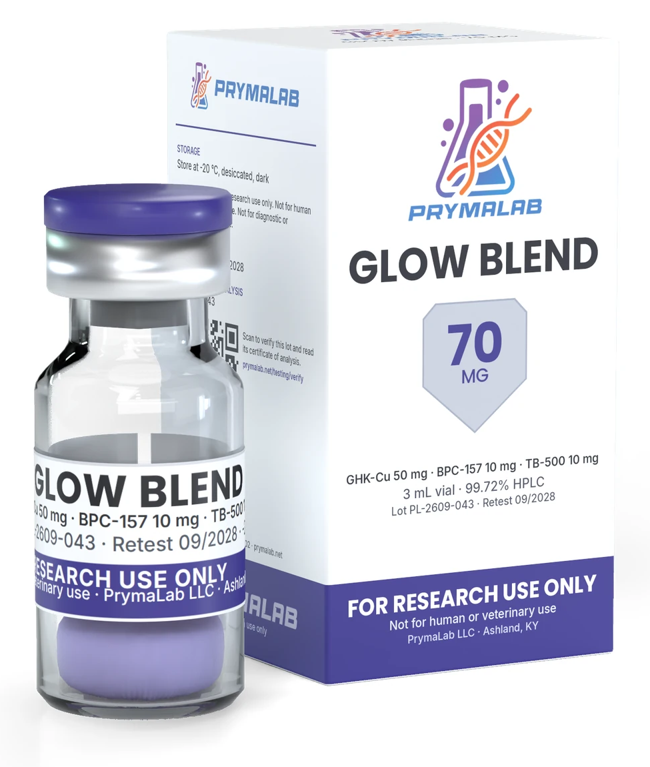
GLOW Blend 70 mg
LYOPHILIZED / 3 mL VIALThe 50 / 10 / 10 mg formula.
- GHK-Cu
- 50 mg
- BPC-157
- 10 mg
- TB-500
- 10 mg
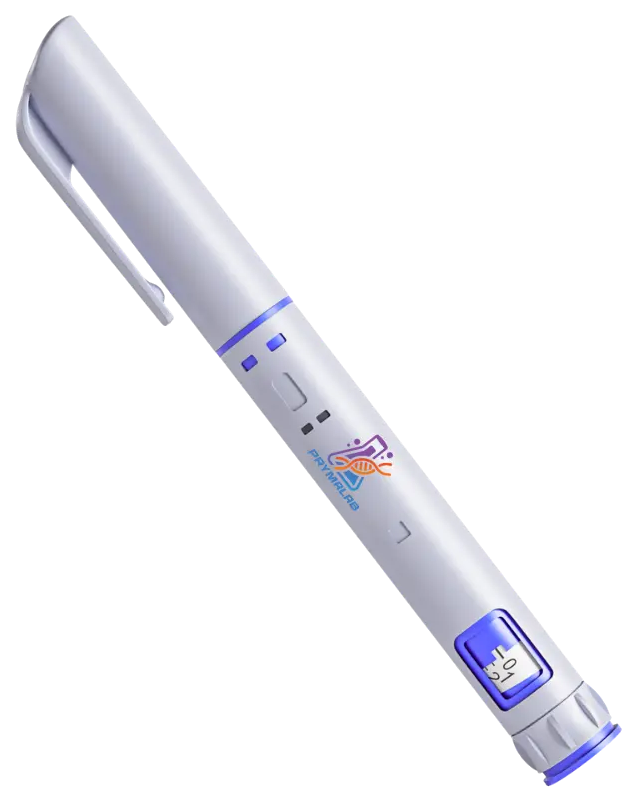
GLOW Autoinjector
PRELOADED / 3 mL DEVICEThe ready-filled solution format.
- GHK-Cu
- 107 mg
- BPC-157
- 21.4 mg
- TB-500 (Thymosin β4)
- 21.4 mg
Does the pen contain KPV?
The supplied GLOW pen specification lists GHK-Cu, BPC-157 and TB-500; KPV is not one of its ingredients. It declares 107 mg GHK-Cu, 21.4 mg BPC-157 and 21.4 mg TB-500 per 3 mL pen. These rounded component figures total approximately 150 mg.[8]
The pen therefore remains a GLOW formulation even though its total contents exceed those of an 80 mg KLOW vial. Format and total quantity do not determine whether a blend is GLOW or KLOW.
The 3 mL pen figure describes a solution fill. For the freeze-dried products, the 3 mL vial description refers to container capacity; it does not specify a prepared concentration. Compare the actual product details on the Buy page, or read more about GLOW formulation overview.
Are GLOW and KLOW Dosages Interchangeable?
No interchangeable human regimen is established by the sources used in this comparison. Adding KPV changes the composition, and matching a vial total or a syringe marking does not establish matching quantities of every ingredient.
A premixed formulation fixes its ingredient proportions. Changing the amount of mixture changes all of its components together; it does not adjust KPV independently. Reconstitution changes concentration, not the ingredients or their relative mass proportions.
The GLOW dosage page explains formulation and concentration questions. It should not be treated as validation of a KLOW protocol, and a device setting should never be inferred from a photograph or a different product's chart.
Does KPV make KLOW safer?
The cell and mouse findings do not answer that question. FDA's published safety information notes important gaps in human exposure data for KPV and limited human safety data for injectable GHK-Cu, including potential concerns involving aggregation and peptide-related impurities.[9]
These products are presented as laboratory research materials, not self-treatment instructions. Personal medical decisions require a licensed clinician. The GLOW safety overview separates the available evidence from claims that have not been established.
Quality, COAs and Price: Compare More Than Milligrams
Check the report for the named product and batch. The supplied GLOW certificates report 99.70% RP-HPLC area purity for lot PL-2609-042 and 99.72% for lot PL-2609-043. They identify three components by LC-MS and state that the testing was performed in-house by PrymaLab.[1, 2]

Reported RP-HPLC area purity
In-house manufacturer reportCertificate PL-26-00042Open original COA ↗
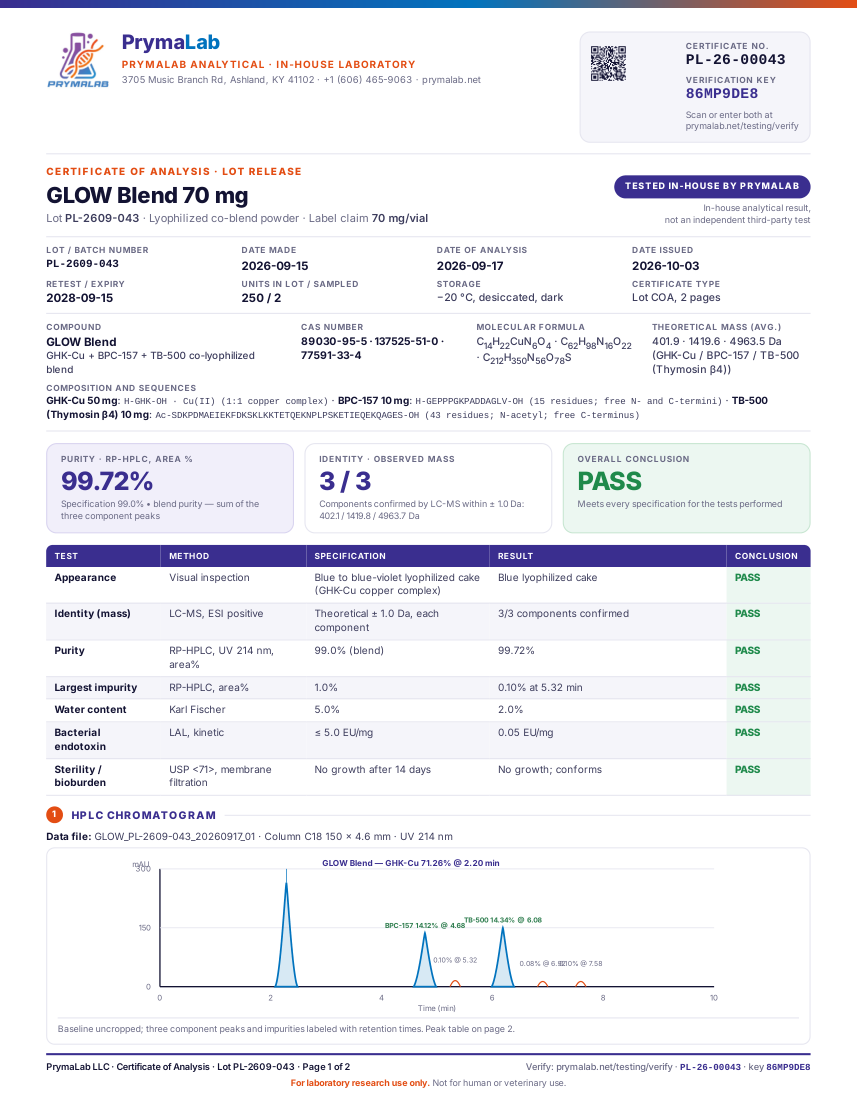
Reported RP-HPLC area purity
In-house manufacturer reportCertificate PL-26-00043Open original COA ↗
Those results describe the sampled lots; they do not measure comparative effectiveness. Adding KPV also adds another component that a KLOW analysis needs to identify. A three-component report should not be presented as documentation for a four-component product.
Is KLOW better value?
That depends on the offer and whether the additional ingredient is needed for the work. Compare ingredient amounts, presentation, documentation and delivered price. A lower price per total milligram does not necessarily mean a lower cost for the particular component or specification you require.
For the 70 mg and 80 mg formulations above, the shared labeled amounts are unchanged. A price premium therefore needs to be evaluated against the additional KPV and any differences in the actual service or documentation, rather than an assumed upgrade in all three shared ingredients.
Use Quality + COA to interpret the testing, COA report library for the available records, and the pricing and purchasing information for like-for-like price comparisons.
GLOW vs KLOW: Frequently Asked Questions
What is the main difference between GLOW and KLOW?
Is KLOW 80 mg just GLOW 70 mg plus KPV?
For the specified pair in this article, yes at the level of declared composition: the shared 50/10/10 mg amounts remain unchanged and 10 mg KPV is added. This comparison should not be assumed to describe every supplier's products.
Is GLOW 50 mg the same ratio as GLOW 70 mg?
Which is better for skin or recovery?
The sources reviewed do not establish a finished-blend winner for either outcome. Both include the three shared ingredients. Adding KPV introduces another research component, not proof of better cosmetic or recovery results.
Does the GLOW autoinjector contain KPV?
No KPV appears in the supplied GLOW pen specification. It lists approximately 150 mg total of GHK-Cu, BPC-157 and TB-500 in a 3 mL solution format.[8]
Can GLOW and KLOW be combined?
Their shared ingredients would overlap. A combined quantity would need to account for every component; this article does not recommend combining them or provide a human-use schedule.
Where can I compare GLOW products and reports?
Use the Buy page to compare the 50 mg vial, 70 mg vial and autoinjector. Quality + COA explains the analytical information, and COA report library provides the available documents.
Explore the GLOW Range
Compare the two vial formulations or the preloaded autoinjector. Review the specifications, then open your preferred format for purchasing options.
Buy VialBuy AutoinjectorFor laboratory research use only. Not for human or veterinary use.
References and Product Documentation
Manufacturer documents support composition and reported analytical results. The research papers support the stated ingredient findings, not a clinical ranking of the finished blends.
- 1GLOW Blend 50 mg - lot PL-2609-042; certificate PL-26-00042Supplied manufacturer COA; in-house analytical results
- 2GLOW Blend 70 mg - lot PL-2609-043; certificate PL-26-00043Supplied manufacturer COA; in-house analytical results
- 3PrymaLab - KLOW Blend 80 mg product specificationManufacturer-declared composition; not clinical evidence
- 4Dalmasso et al. (2008) - PepT1-mediated KPV uptake and intestinal inflammationPrimary study: human cell lines and mouse colitis models
- 5Maquart et al. (1988) - GHK-Cu and collagen synthesis in fibroblast culturesPrimary laboratory study
- 6Chang et al. (2011) - BPC-157, tendon explants and cell migrationPrimary tissue and cell study
- 7Guarnera et al. (2010) - Topical thymosin beta-4 in venous ulcersPrimary randomized Phase II study; a different preparation and route
- 8GLOW autoinjector - supplied product specificationSupplied specification screenshot referencing PL-SDS-070
- 9FDA - Safety concerns for certain substances used in compoundingRegulatory safety information; not comparative efficacy evidence