Which GLOW Formulation Does the Chart Describe?
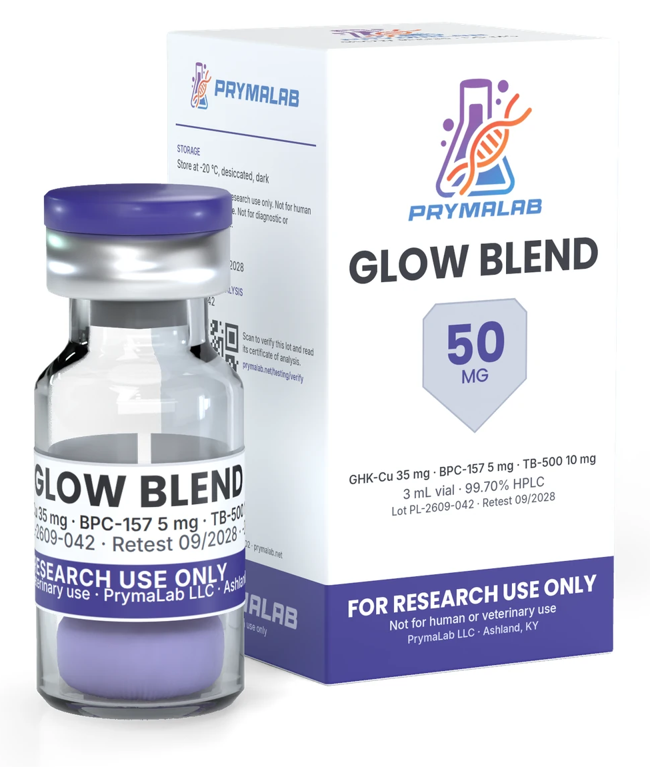
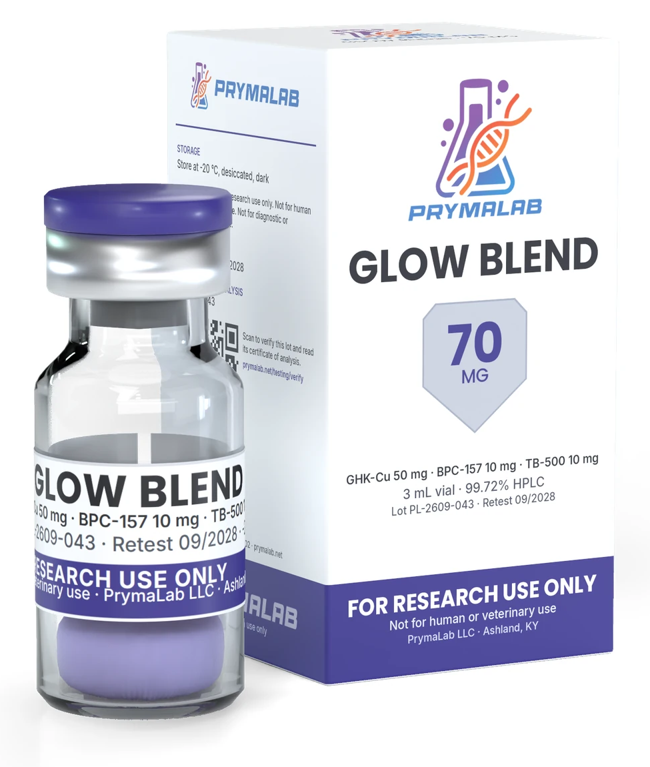
The supplied 50 mg and 70 mg certificates list different ingredient proportions. The pen is a prepared liquid with its own specification. All component amounts below are listed in the same order: GHK-Cu, BPC-157, then TB-500.[3, 4, 5]
50 mg
35 mg GHK-Cu
5 mg BPC-157
10 mg TB-500
70 mg
50 mg GHK-Cu
10 mg BPC-157
10 mg TB-500
3 mL
107 mg GHK-Cu
21.4 mg BPC-157
21.4 mg TB-500
The ratio labels are calculated from those declared quantities. Matching a blend name is not enough to match a chart: the 50 mg product is not simply a smaller amount of the 70 mg formulation.
Both vial certificates describe the TB-500 component as 43-residue thymosin beta-4. This identity comes from the supplied documents; it should not be silently replaced with a fragment specification taken from a general peptide guide.[3, 4]
Keep the bottle and solution measurements separate. A 3 mL vial capacity is not a 3 mL liquid fill, and it does not tell you how much diluent has been added. A dry product has no ready-to-use concentration in mg/mL.
The full product identity and composition belong in the GLOW formulation overview.
GLOW 70 mg Dosage: What the Linked Articles Report
Both references publish an approximately 2.33 mg total-blend, once-daily amount for their 70 mg pre-blend scenario. Peptide Dosing Protocols explicitly calls its dosing community-derived. PeptideDoseInfo presents its schedule as literature-based.[1, 2]
| Source | Reported daily amount | How the source frames it |
|---|---|---|
| PeptideDoseInfo | Approximately 2.33 mg of combined blend | A research-reference schedule |
| Peptide Dosing Protocols | Approximately 2.33 mg of combined blend | Community-derived guidance |
Agreement between two websites does not establish clinical validation. Neither article identifies a human trial validating the exact combination and schedule it proposes. That is a limitation of these references, not a claim that we have searched every publication.
Also distinguish a total-blend amount from the quantity of an individual component. The same total mass can contain different amounts of BPC-157 or thymosin beta-4 when the formulation changes.
We have not adapted the separate-vial schedules in the second guide into instructions for these premixed products. Independently selecting quantities of three separate substances is a different proposition from using a fixed-ratio mixture.[2]
See the benefits and research review for the separate question of what the ingredient studies actually tested.
GLOW Reconstitution: Check the Concentration Calculation
Both articles use a 70 mg blend and describe 3.0 mL of bacteriostatic water in their preparation example. They report an approximate total concentration of 23.3 mg/mL.[1, 2]
Our arithmetic check: that concentration corresponds to a final solution volume of 3.0 mL. The calculation below checks the numbers; it is not a product-specific preparation instruction.
| Component | Mass in the 70 mg formulation | At 3.0 mL final volume |
|---|---|---|
| GHK-Cu | 50 mg | 16.67 mg/mL |
| BPC-157 | 10 mg | 3.33 mg/mL |
| TB-500 | 10 mg | 3.33 mg/mL |
| Combined blend | 70 mg | 23.33 mg/mL |
Individual figures are rounded; the total is calculated before rounding. The general relationship is concentration = amount / final solution volume. Changing the volume changes concentration, but does not change the original ingredient mass or ratio.
What must be specified before preparing a vial?
The relevant preparation document should identify the exact formulation, intended laboratory application, compatible diluent, final volume, handling method and stability conditions. A capacity printed on a container does not establish any of those details.
The supplied certificates document the dry lots and analytical testing. Their chromatographic sample-preparation method is an analytical method, not a human-use reconstitution recipe.[3, 4]
Do not transfer the 70 mg article calculation to the 50 mg vial or the preloaded pen. Their composition or presentation differs. Device markings also cannot be converted into milligrams without a verified device volume and concentration.
Review quality and testing alongside the COA report library.
Cycle Guidelines: The Published Schedules Do Not Match
The two sources give different durations and breaks. The table preserves their individual claims rather than creating a new blended recommendation.[1, 2]
| Source / scenario | Claimed course length | Claimed break |
|---|---|---|
| PeptideDoseInfo - standard | 4 weeks | 2-4 weeks |
| PeptideDoseInfo - extended | 6 weeks | 3-4 weeks |
| Peptide Dosing Protocols - standard | 4-6 weeks | 2-4 weeks |
| Peptide Dosing Protocols - extended | 8-12 weeks | 4-8 weeks |
Elsewhere, Peptide Dosing Protocols describes a 30-60-day on-period with an equal off-period. That is another formulation of its cycling advice, not the same rule as every row above.[2]
A fixed ingredient ratio does not determine the safe frequency, maximum exposure or necessary break. Those questions require evidence about the relevant preparation and intended use, not just the arithmetic of the vial.
Course length and solution stability are also separate. Material remaining in a container does not prove it is suitable to keep using, and a dry-powder retest date cannot be treated as an expiry date for a prepared solution.
For that reason, this page does not turn a cycle claim into a suggested order quantity, an escalation schedule or an automatic repeat-purchase interval. Read the GLOW safety overview before interpreting any online regimen as personal guidance.
GLOW Injection Sites: What the Sources Actually Establish
PeptideDoseInfo names the abdomen, thigh and upper arm as subcutaneous locations. Peptide Dosing Protocols discusses subcutaneous use and site rotation. These are descriptions of the articles, not GLOW-specific evidence that a particular site is safe or effective.[1, 2]
An anatomical site
A location named in a general injection guide does not establish that this research product is suitable for administration there.
The product and route
Suitability depends on the actual preparation and clinical context. A preloaded device does not establish those conditions.
Neither reference supplies comparative clinical evidence showing that one injection location improves outcomes for these specific products. We therefore do not label any site as the preferred location, suggest injecting near an injury, or provide a needle-angle and insertion checklist.
FDA identifies limited safety information for BPC-157 and potential immune-response and impurity-related concerns for injectable GHK-Cu. These are additional safety considerations beyond the two requested articles.[6]
A person considering administration needs product-specific direction and training from a licensed clinician, not a procedure inferred from an educational webpage. A research-use disclaimer does not turn that procedure into an approved medical use. FDA has also considered surrounding use claims when evaluating research-labeled products.[7]
The GLOW safety overview contains the related evidence discussion. This page is a source review, not injection training.
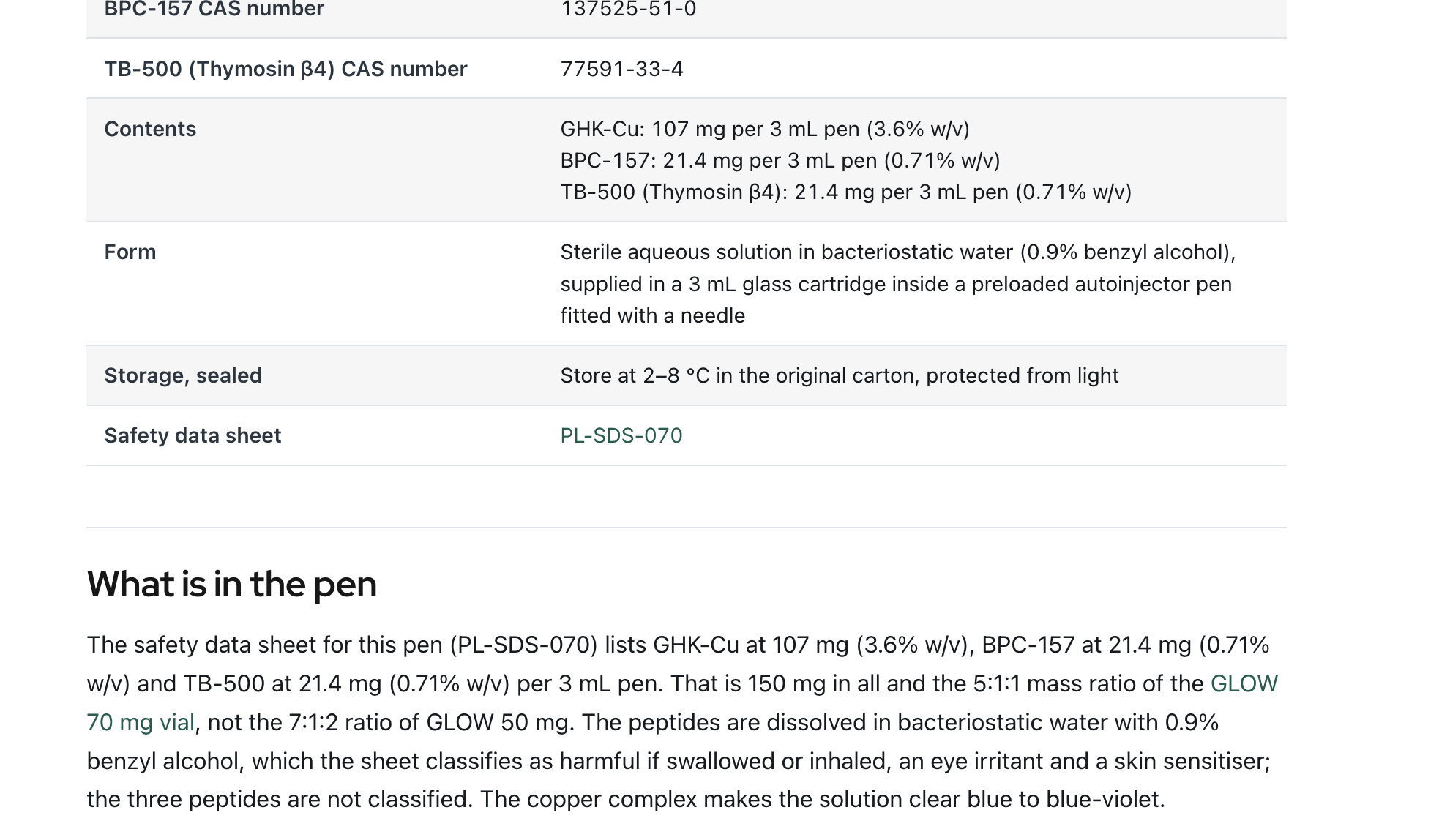
GLOW Autoinjector: Contents, Concentration and Device Settings
The supplied product-page excerpt states the following quantities per 3 mL pen and refers to safety data sheet PL-SDS-070. These details come from that excerpt, not from either dosing article.[5]
3 mL preloaded format| Component | Per 3 mL pen | Calculated per mL |
|---|---|---|
| GHK-Cu | 107 mg | 35.67 mg/mL |
| BPC-157 | 21.4 mg | 7.13 mg/mL |
| TB-500 | 21.4 mg | 7.13 mg/mL |
The displayed component amounts sum to 149.8 mg. The product uses a nominal 150 mg / 3 mL, or 50 mg/mL, description. The small difference is consistent with rounding the component quantities; the rounded numbers should not be presented as an exact measured assay.
Its stated mass ratio is 5:1:1, matching the proportions of the 70 mg formulation, rather than the 7:1:2 proportions of the 50 mg vial. Matching proportions still do not establish an interchangeable administration setting.
The excerpt describes a solution in bacteriostatic water containing 0.9% benzyl alcohol, supplied in a 3 mL glass cartridge. It is a preloaded liquid, not a powder-reconstitution example.[5]
What about clicks or numbered pen settings?
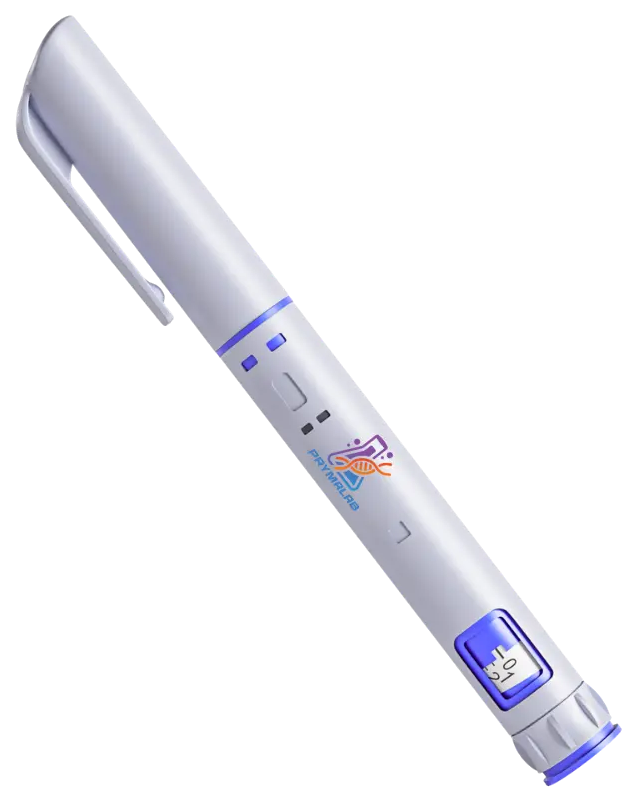
Concentration alone is insufficient. A setting-to-volume specification for the actual device is needed before any setting can be related to a quantity of material. No setting conversion has been inferred from the photograph.
PLACEHOLDER TEXT
This draft field is reserved for verified device-specific information. It must not be populated using a syringe chart or by guessing from another pen. See the GLOW formulation overview for the non-procedural product comparison.
Storage and Batch Documentation
| Material | Supplied storage information | Source |
|---|---|---|
| 50 mg and 70 mg dry vial lots | -20 °C, desiccated, dark | The two supplied certificates |
| Sealed preloaded pen | 2-8 °C, original carton, protected from light | The supplied pen specification excerpt |
These are product-document statements for the material and condition identified, not a universal storage rule for every GLOW preparation.[3, 4, 5]
After reconstitution is a separate question
PeptideDoseInfo claims roughly four weeks for its refrigerated prepared mixture. The other guide lists separate-compound windows, including 1-2 weeks for TB-500 and up to 30 days for the other components. Those statements are not a shared, product-specific stability study of these three products.[1, 2]
Do not select the longest number or convert a cycle length into a usable lifetime. Supplier-supported stability and after-opening conditions are needed for the exact formulation and container.

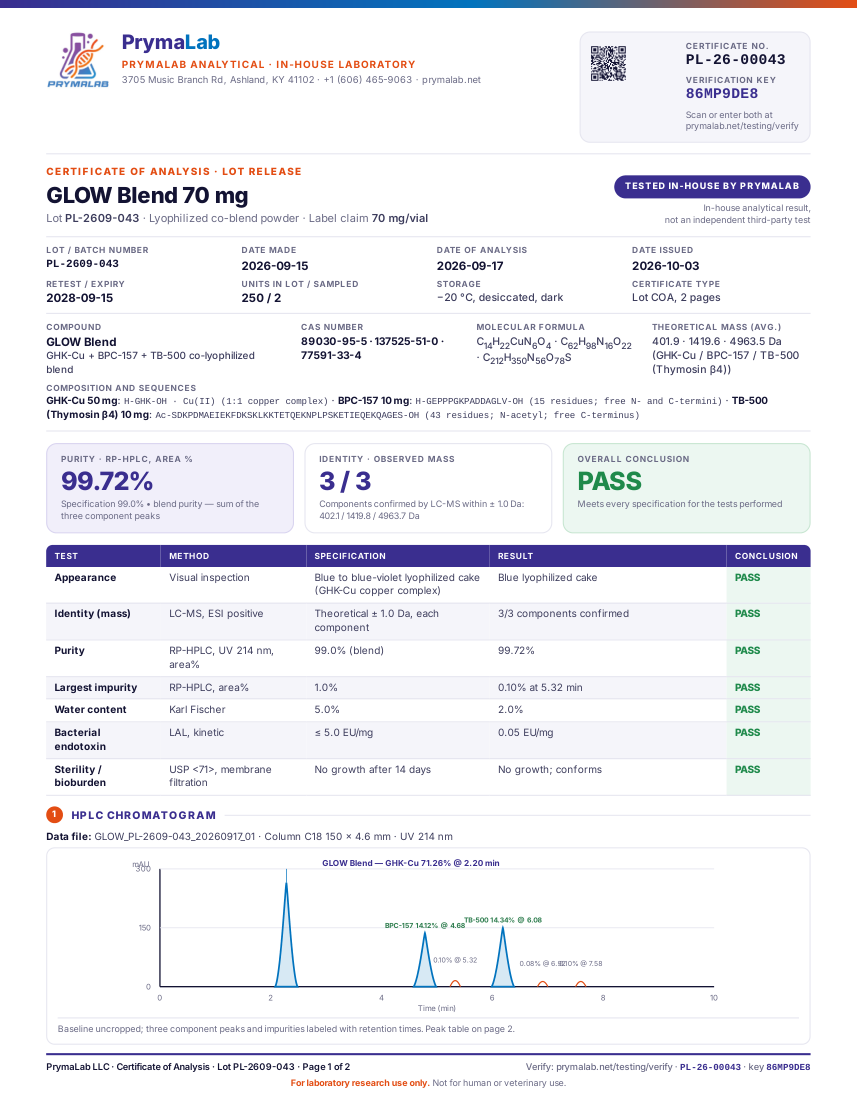
Reported blend purity by RP-HPLC
Lot PL-2609-042Certificate PL-26-00042Open the original two-page report
Reported blend purity by RP-HPLC
Lot PL-2609-043Certificate PL-26-00043Open the original two-page report
The certificates state that testing was performed in-house and that the results apply to the named lots. Their reported purity and identity results are analytical findings; they do not establish a human dose, cycle length or injection site.[3, 4]
Keep the original records intact. For report interpretation, use Quality + COA; for the complete library, use COA report library.
GLOW Peptide Dosage: Frequently Asked Questions
Is the GLOW vial amount the same as a dose?
No. The labeled total is the content of the container. It is not a direction to administer the contents, and it does not establish frequency or treatment duration.
Can I apply a 70 mg chart to the 50 mg vial?
Not without changing the assumptions: the ingredient proportions differ. See the formulation cards at the top of this page. We have not converted the online regimen into a recommendation for the 50 mg product.
Does a 3 mL vial mean I should add 3 mL?
No. Container capacity and prepared solution volume are different measurements. A product-specific preparation instruction must identify the appropriate final volume.
Does the pen use the same concentration as the article example?
No. The supplied pen specification describes a nominal 50 mg/mL prepared product. The article calculation concerns a different preparation. Neither figure alone defines an appropriate dose.
Which cycle from the comparison should I follow?
This page does not select a cycle. It records conflicting online claims and identifies their evidence limitations; it is not a course recommendation for personal use.
Can a COA establish injection safety?
A lot certificate reports the tests performed on sampled material. It does not establish clinical suitability, a treatment schedule or device instructions. Read the testing guide for the scope of the actual records.
Where are the other GLOW guides?
See Benefits for ingredient research, Before & After for outcome claims, and GLOW safety overview for the associated limitations.
Sources and Product Documents
Sources 1 and 2 are the requested protocol pages. Sources 3-5 are the supplied product materials. Sources 6 and 7 provide additional official safety context. Calculations and source comparisons are our analysis; no source is treated as a clinical endorsement.
- 1PeptideDoseInfo - GLOW 70 mg protocolUser-selected protocol article. Its schedules are reported as claims, not clinical validation.
- 2Peptide Dosing Protocols - GLOW stack guideUser-selected protocol article; explicitly describes its schedule as community-derived.
- 3Supplied GLOW 50 mg COA - PL-26-00042User-supplied manufacturer document; lot PL-2609-042. In-house analysis, not an independent test.
- 4Supplied GLOW 70 mg COA - PL-26-00043User-supplied manufacturer document; lot PL-2609-043. In-house analysis, not an independent test.
- 5Supplied GLOW pen specification screenshotUser-supplied product-page excerpt, referring to SDS PL-SDS-070. The underlying SDS was not separately reviewed for this draft.
- 6FDA - Safety risks associated with certain compounding substancesAdditional official context: BPC-157 and injectable GHK-Cu safety uncertainties. The TB-500 fragment entry is not applied to full-length thymosin beta-4.
- 7FDA - Gram Peptides warning letter, March 31, 2026Additional official context on intended-use claims. Not a finding about this proposed website.